

The Capability Architecture: Three Frameworks for the New Work Layer
Tools for mapping how skills and judgment must evolve across the management layer — and why the gap between them is where organizations lose their next generation of leaders.

In AI, Applied Part 4: The Unbossing of the AI Era Workforce I argue that removing the management layer doesn’t compress cost so much as compress capability — the developmental infrastructure through which organizations build judgment over time. The three frameworks below are the applied diagnostic response to that argument. Together they form HAA’s Capability Architecture: a set of tools for mapping not just what people do, but what they must become able to do as AI absorbs the work beneath them.
4.1 — The Manager Capability Shift: From Overseer to Orchestrator
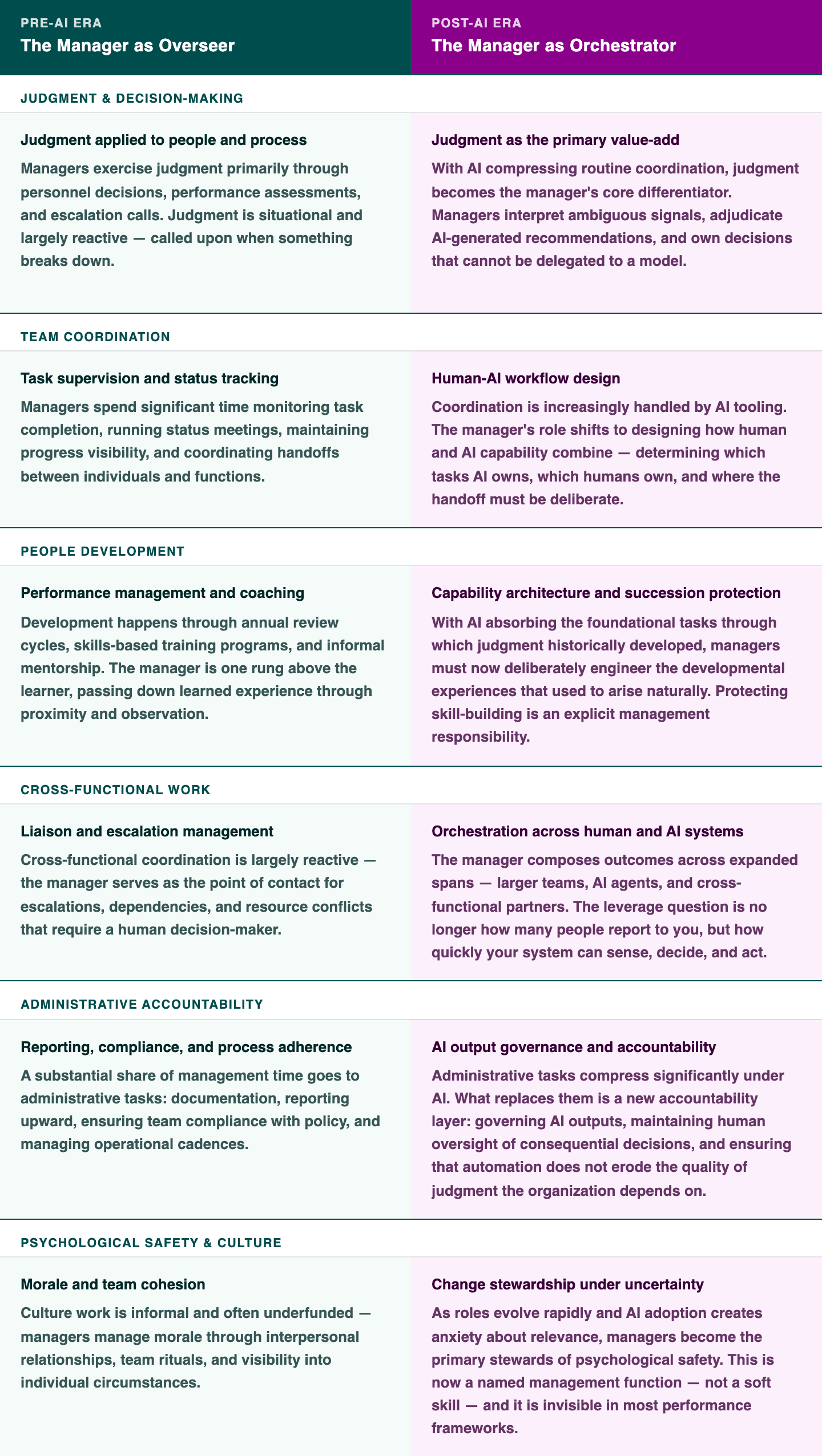
The first framework maps the managerial remit across two eras — not as a before-and-after but as a diagnostic of what is being gained, lost, and dangerously ignored in the transition. The six capability dimensions it tracks — judgment, coordination, people development, cross-functional work, administrative accountability, and psychological safety — don’t disappear in the AI era; they transform. And the organizations that treat transformation as compression — assuming the new work is simply less work — are the ones generating the executive burnout and the team directionless.
The framework is designed to be used at the department level: a diagnostic for identifying which managerial capabilities your organization is actively developing, which it is inadvertently eroding, and which it has stopped measuring altogether because they don’t yet appear in a performance framework.
4.2 — The IC Capability Shift: From Executor to Designer
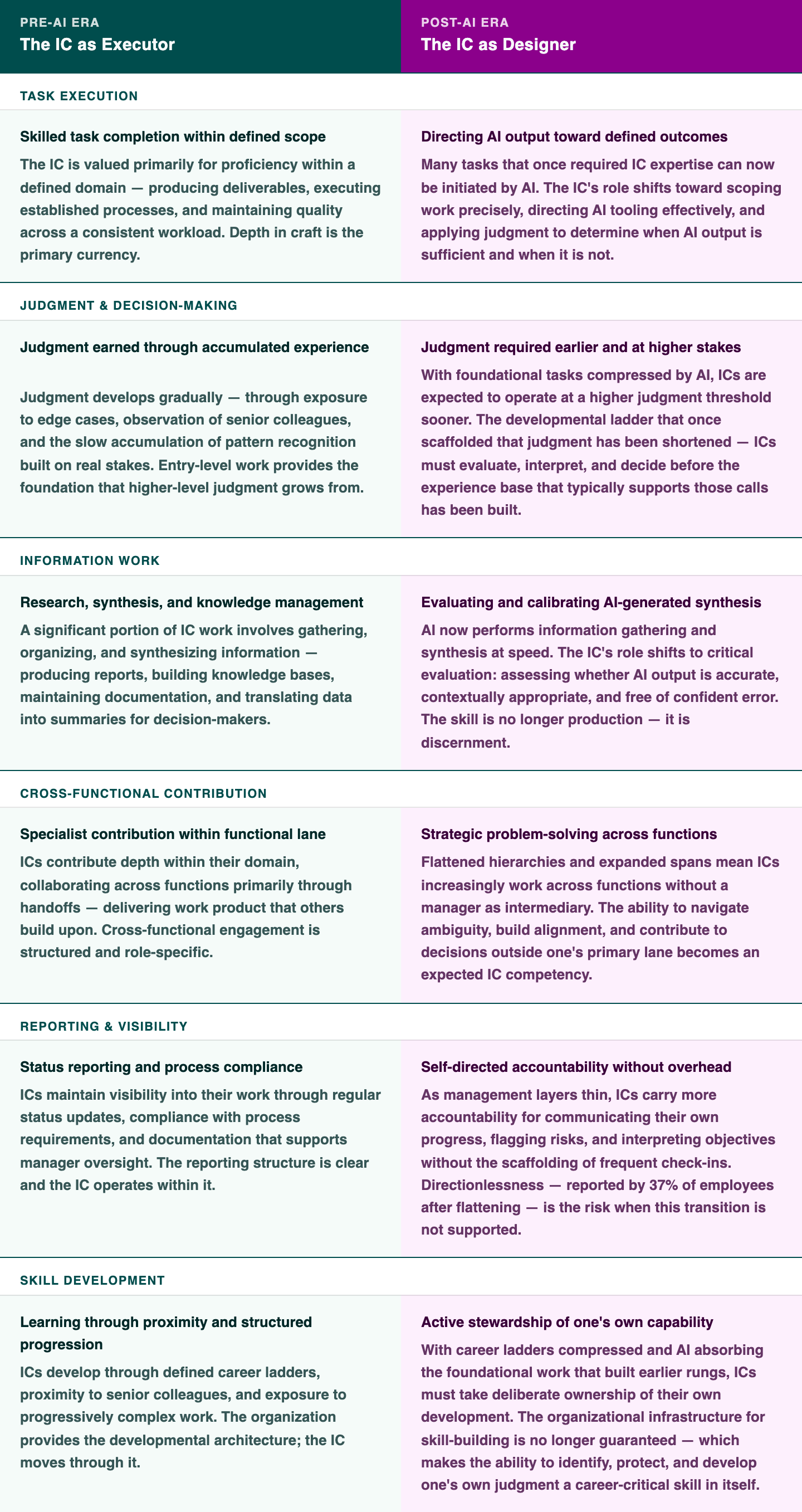
The second framework applies the same diagnostic logic to the individual contributor — the role that unbossing has most structurally exposed. ICs are now expected to operate at a higher judgment threshold earlier, with less scaffolding, in a flatter structure that offers fewer natural opportunities to observe, fail, and develop. The framework tracks six capability dimensions across the same two eras, with particular attention to what gets lost when AI absorbs the foundational tasks through which judgment was historically built.
The central tension the framework surfaces: the post-AI IC is expected to evaluate AI output, navigate cross-functional ambiguity, and exercise self-directed accountability — all capabilities that used to develop gradually, through proximity to managers and exposure to structured progression. When that ladder is removed, the IC doesn’t automatically rise to meet the new bar. The organization has to deliberately design the conditions that allow it.
4.3 — The Hierarchy of Critical Thinking vs Execution Skills
The third framework is the synthesis. It maps two axes — skill execution and critical thinking — against each other to produce a four-quadrant diagnostic of where human-AI cognition is most and least effectively combined. The skill axis runs from task completion through orchestration. The critical thinking axis runs from interpretation through judgment. Where they meet in the upper right is the Designer Zone: the domain of human capability that AI cannot replicate and organizations cannot afford to hollow.
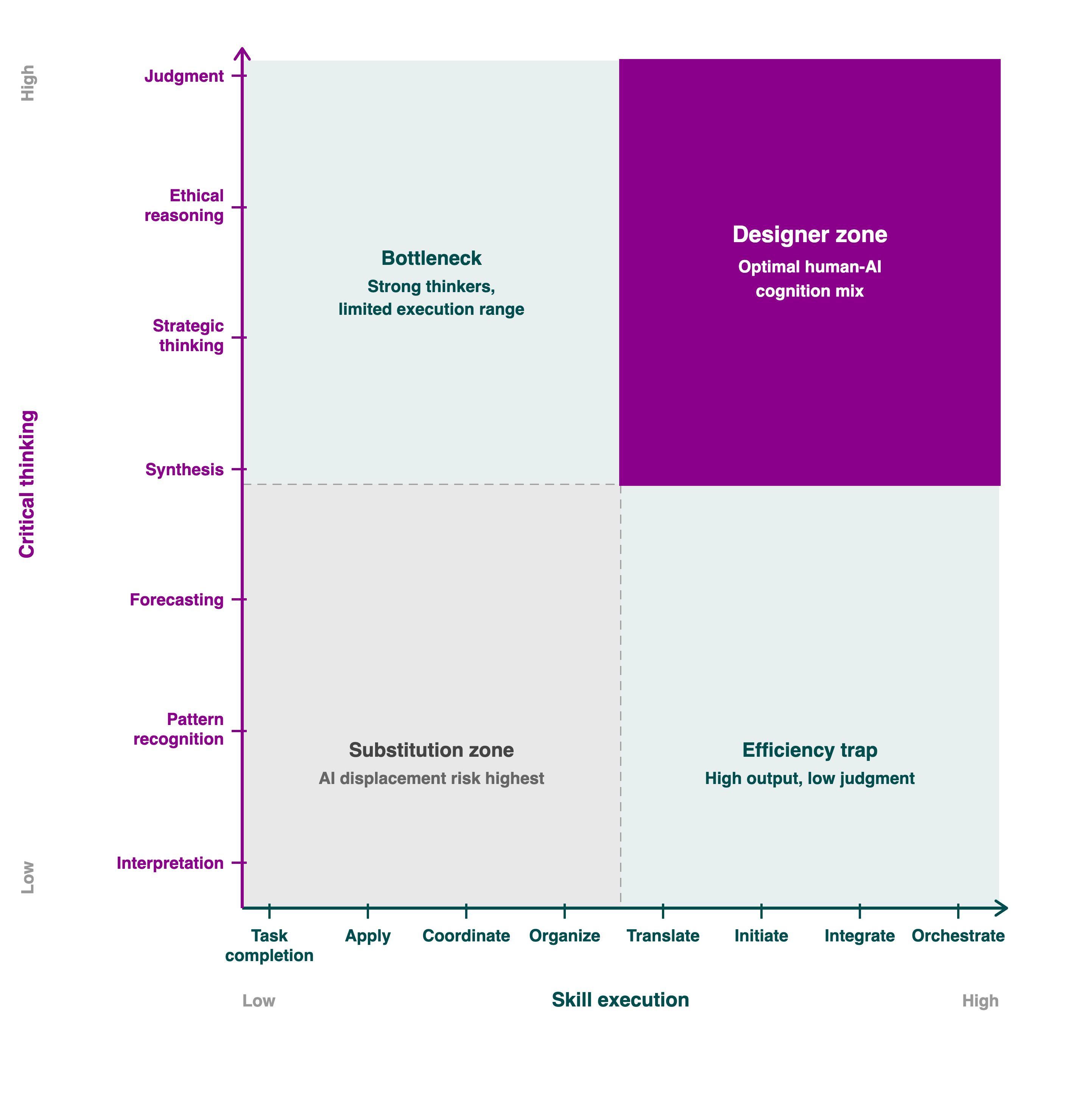
The three other quadrants are equally instructive. The Substitution Zone — low skill execution, low critical thinking — is where AI displacement risk is highest and where most unbossing decisions are being made without sufficient examination of what exits with the role. The Efficiency Trap captures high skill execution without the critical thinking layer that makes that skill consequential. The Bottleneck captures the inverse: strong judgment capacity without the execution range to act on it.
The framework is not a ranking of roles. It is a map of cognitive conditions — one that organizational leaders can use to assess whether their current human-AI design is building toward the Designer Zone or quietly redistributing people into the other three.